
When Architecture Becomes Art
Around the world, a handful of structures do far more than shelter the people inside them. They stop you in your tracks, make your jaw drop, and force you to ask: how was this even built? The most famous unique buildings in the world are landmarks of human ambition — each one a bold statement about what architecture can be when vision trumps convention.
From a basilica in Barcelona that has taken over 140 years to build, to a titanium-clad museum perched on a Spanish riverbank, these structures are proof that design, at its highest level, is indistinguishable from art. Whether you’re a seasoned traveler, an architecture enthusiast, or someone planning your next dream destination, this list will inspire you.
And for those of us in Guwahati, these global marvels serve as a powerful reminder: great design elevates communities. At Ambika Group, we believe every building — whether a luxury apartment or a commercial complex — should aspire to that same standard of excellence.
What Makes a Building Truly Unique?
Before we explore the list, it’s worth understanding what sets a building apart from the rest. Unique architecture is defined by several qualities:
- Bold, unconventional form that breaks from the norms of its era
- Cultural or historical significance that gives the structure deeper meaning
- Engineering innovation — solving problems no architect had solved before
- Emotional impact — the ability to make visitors feel something profound
- Global recognition and enduring admiration across generations
Buildings that check all these boxes don’t just appear in travel brochures. They shape how we think about cities, identity, and the future of the built environment.
The 10 Most Famous Unique Buildings in the World
1. Sagrada Família — Barcelona, Spain
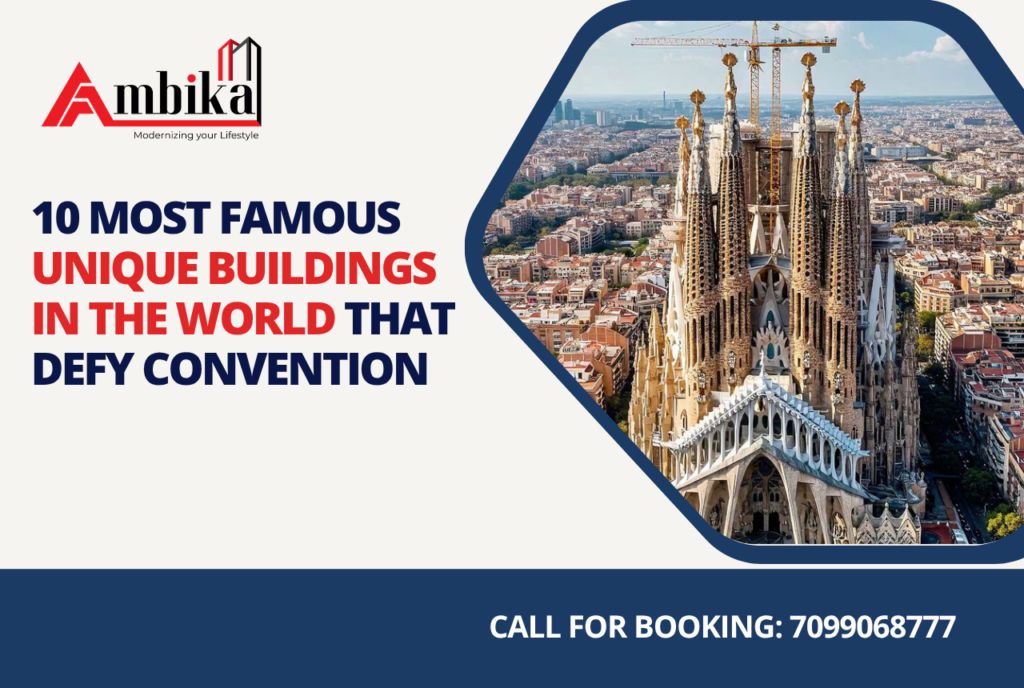
Perhaps no building in the world better captures the intersection of spirituality, mathematics, and sheer artistic ambition than Antoni Gaudí’s Sagrada Família. Construction began in 1882 — and is only now approaching completion, over 140 years later. Gaudí, who died in 1926 after being struck by a tram, is buried in a crypt within the very church he devoted his life to.
The basilica blends Gothic, Art Nouveau, and Catalan Modernisme styles. Its interior features soaring tree-like columns that branch into vaulted ceilings, while its stained glass windows flood the space with vibrant colour. Once complete with all 18 towers, it will stand as the tallest church in the world. Learn more at the official Sagrada Família website.
- Architectural style: Gothic / Art Nouveau / Catalan Modernisme
- Architect: Antoni Gaudí
- UNESCO World Heritage Site
2. Sydney Opera House — Sydney, Australia
Few buildings are as immediately recognizable as the Sydney Opera House. Designed by Danish architect Jørn Utzon following an international competition in 1957, the structure sits on Bennelong Point in Sydney Harbour, its interlocking shell-like vaults rising against the backdrop of the water.
Clad in over one million mosaic tiles that shimmer in the Australian sun, the Opera House is a UNESCO World Heritage Site and one of the defining symbols of 20th-century architecture. Explore it further on the Sydney Opera House official site.
- Architectural style: Expressionist modernism
- Architect: Jørn Utzon
- Opened: 1973
3. Guggenheim Museum Bilbao — Bilbao, Spain
When Frank Gehry’s titanium-clad Guggenheim Museum opened in 1997 on the banks of the Nervión River in Bilbao, it didn’t just house art — it became art. The building’s undulating, sculptural form is considered one of the most important architectural works of the 20th century.
The so-called ‘Bilbao Effect’ refers to how a single iconic building revitalised an entire city, transforming Bilbao from an industrial port into a global cultural destination. Its interior atrium is flooded with light through a veil of glass, with 20 galleries spread across three levels. Discover more at the Guggenheim Bilbao website.
- Architectural style: Deconstructivism
- Architect: Frank Gehry
- Titanium cladding, riverfront location
4. The Taj Mahal — Agra, India
Built by Mughal Emperor Shah Jahan as a mausoleum for his beloved wife Mumtaz Mahal, the Taj Mahal is widely regarded as the finest example of Mughal architecture in the world. Commissioned in 1632, the white marble complex took over 20 years to complete and employed more than 20,000 artisans.
It is consistently ranked as the most beautiful building in the world, blending Persian, Ottoman, and Indian architectural elements into a perfectly symmetrical masterpiece. A UNESCO World Heritage Site and one of the New Seven Wonders of the World, it draws millions of visitors annually.
- Architectural style: Mughal
- Completed: 1653
- UNESCO World Heritage Site & New Seven Wonder of the World
5. The Lotus Temple — New Delhi, India
India contributes another extraordinary structure to this list. Completed in 1986, the Lotus Temple in New Delhi is shaped like a blooming lotus flower, with 27 free-standing marble-clad petals. It serves as the Mother Temple of the Bahá’í Faith and is open to people of all religions.
Its striking design has earned numerous international architecture awards, and it remains one of the most visited buildings in the world. The Lotus Temple is a beautiful reminder that architecture can be a powerful symbol of unity and peace.
- Architectural style: Modern / Organic
- Architect: Fariborz Sahba
- Multiple international architecture awards
6. Marina Bay Sands — Singapore
A newer addition to the world’s architectural icons, Marina Bay Sands features three 55-storey hotel towers connected by a breathtaking sky park — a cantilevered platform stretching 340 metres across their rooftops. The 150-metre infinity pool at the top offers one of the most dramatic urban views on Earth.
Designed by architect Moshe Safdie, the resort is one of Asia’s most recognisable modern landmarks and a symbol of Singapore’s forward-thinking ambition. It proves that contemporary architecture can be just as awe-inspiring as any ancient monument.
- Architectural style: Contemporary / Modernist
- Architect: Moshe Safdie
- Opened: 2010
7. The Leaning Tower of Pisa — Pisa, Italy
Sometimes a structural mistake becomes a world-famous landmark. The Leaning Tower of Pisa, the circular bell tower of Pisa Cathedral, took 199 years to build and is famous for its near four-degree tilt — the result of soft foundations on one side. Completed in the 14th century, the tower stands 56 metres tall and features seven floors adorned with classical columns.
What began as an engineering error became one of Italy’s greatest tourist attractions, drawing visitors who pose for the classic ‘holding up the tower’ photograph from Piazza del Duomo.
- Constructed: 1173–1372 AD
- Leans approximately 3.97 degrees
- Part of the Piazza dei Miracoli UNESCO site
8. The Cube Houses — Rotterdam, Netherlands
Rotterdam is known for bold, progressive architecture, and perhaps nothing exemplifies this more than its iconic Cube Houses. Designed by Piet Blom in the 1970s, these yellow cube-shaped homes are tilted at 45 degrees, each representing an abstract tree. Together they form a ‘forest’ of homes above a pedestrian bridge.
Some of the cubes are open to visitors as a museum, offering a fascinating glimpse into life inside this unconventional residential experiment. They remain one of the most photographed examples of avant-garde housing design in the world.
- Architectural style: Avant-garde / Structuralism
- Architect: Piet Blom
- Built: 1984
9. Fallingwater — Pennsylvania, USA
Designed by legendary American architect Frank Lloyd Wright in 1934 for the Kaufmann family, Fallingwater is perhaps the most famous private residence ever built. The house appears to float over a 30-foot waterfall, with dramatic cantilevered terraces extending over the stream below.
It represents Wright’s philosophy of ‘organic architecture’ — designing structures that exist in harmony with their natural surroundings. Today it is a UNESCO World Heritage Site and is open to visitors. Learn more at fallingwater.org.
- Architectural style: Organic modernism
- Architect: Frank Lloyd Wright
- UNESCO World Heritage Site
10. Museum of the Future — Dubai, UAE
One of the most visually striking buildings to emerge in recent years, the Museum of the Future in Dubai opened in 2022. Its torus-shaped (donut-like) exterior is clad in stainless steel panels engraved with Arabic calligraphy, and it appears to float above a green hill.
Widely praised as one of the most beautiful modern buildings in the world, it houses exhibitions exploring emerging technologies and humanity’s possible futures. It represents exactly how contemporary architecture can inspire wonder while serving a meaningful purpose. Explore it at the Museum of the Future website.
- Architectural style: Futurist
- Opened: 2022
- Torus shape clad in laser-cut stainless steel
What Are the 7 Different Types of Architecture?
The buildings above represent a wide spectrum of architectural styles. Understanding these styles helps us appreciate why each structure looks and feels unique. Here are the seven major types of architecture you’ll encounter around the world:
- Classical Architecture — Rooted in ancient Greece and Rome; emphasises symmetry, columns, and proportion (e.g., the Pantheon in Rome).
- Gothic Architecture — Characterised by pointed arches, ribbed vaults, and soaring heights; common in medieval cathedrals (e.g., Notre-Dame de Paris).
- Baroque Architecture — Ornate, dramatic, and theatrical; used extensively in European palaces and churches in the 17th–18th centuries.
- Modernist Architecture — Clean lines, minimal ornamentation, and a focus on function over form; emerged in the 20th century.
- Deconstructivism — Deliberately fragmented, non-linear designs that challenge traditional notions of structure (e.g., Guggenheim Bilbao).
- Organic Architecture — Buildings designed in harmony with nature and their surroundings (e.g., Fallingwater).
- Futurist Architecture — Forward-looking designs that embrace technology, sustainability, and experimental forms (e.g., Museum of the Future).
Why Great Architecture Matters for Your City
The buildings on this list are more than tourist attractions. They are symbols of identity, catalysts for economic growth, and proof that a city’s skyline reflects its ambitions. The Guggenheim Bilbao revitalised an entire city. The Sydney Opera House defined a nation’s cultural identity. The Taj Mahal made a city world-famous.
In Guwahati, we are in the midst of our own architectural transformation. As Northeast India’s fastest-growing urban centre, the city is attracting investment, talent, and vision. The buildings being constructed today will define the skyline — and the identity — of Guwahati for generations to come.
At Ambika Group, established in 2002 and recognised as one of the best real estate developers in Guwahati, we understand this responsibility deeply. Every residential complex and commercial space we build is designed with quality, innovation, and longevity in mind — contributing to a city that can hold its own on any global stage.
How Unique Architecture Inspires Modern Real Estate
The influence of great architecture extends well beyond museums and landmarks. Today’s residential and commercial real estate is increasingly shaped by the same principles: bold design, functional innovation, sustainability, and a sense of place.
Homebuyers and businesses are no longer simply looking for four walls and a roof. They want spaces that inspire. They want buildings that integrate natural light, green spaces, and community-focused design. They want architecture that tells a story.
This is the direction in which Guwahati’s real estate sector is headed — and Ambika Group is proud to be at the forefront of this evolution. From serene residential plots to strategically located commercial developments, our portfolio reflects a commitment to design that goes beyond the ordinary.
Conclusion: Buildings That Change the World
The famous unique buildings in the world — from Gaudí’s unfinished masterpiece in Barcelona to the futuristic gleam of Dubai’s Museum of the Future — remind us that architecture at its best is transformative. These structures don’t just occupy space; they reshape how we see ourselves and our world.
Whether you’re planning a trip to see these landmarks in person, drawing inspiration for your next design project, or simply exploring the boundaries of human creativity, we hope this guide has sparked your imagination.
And if you’re looking to invest in quality real estate in Guwahati — a city building its own architectural legacy — explore Ambika Group’s developments and discover spaces designed with the same passion for excellence.