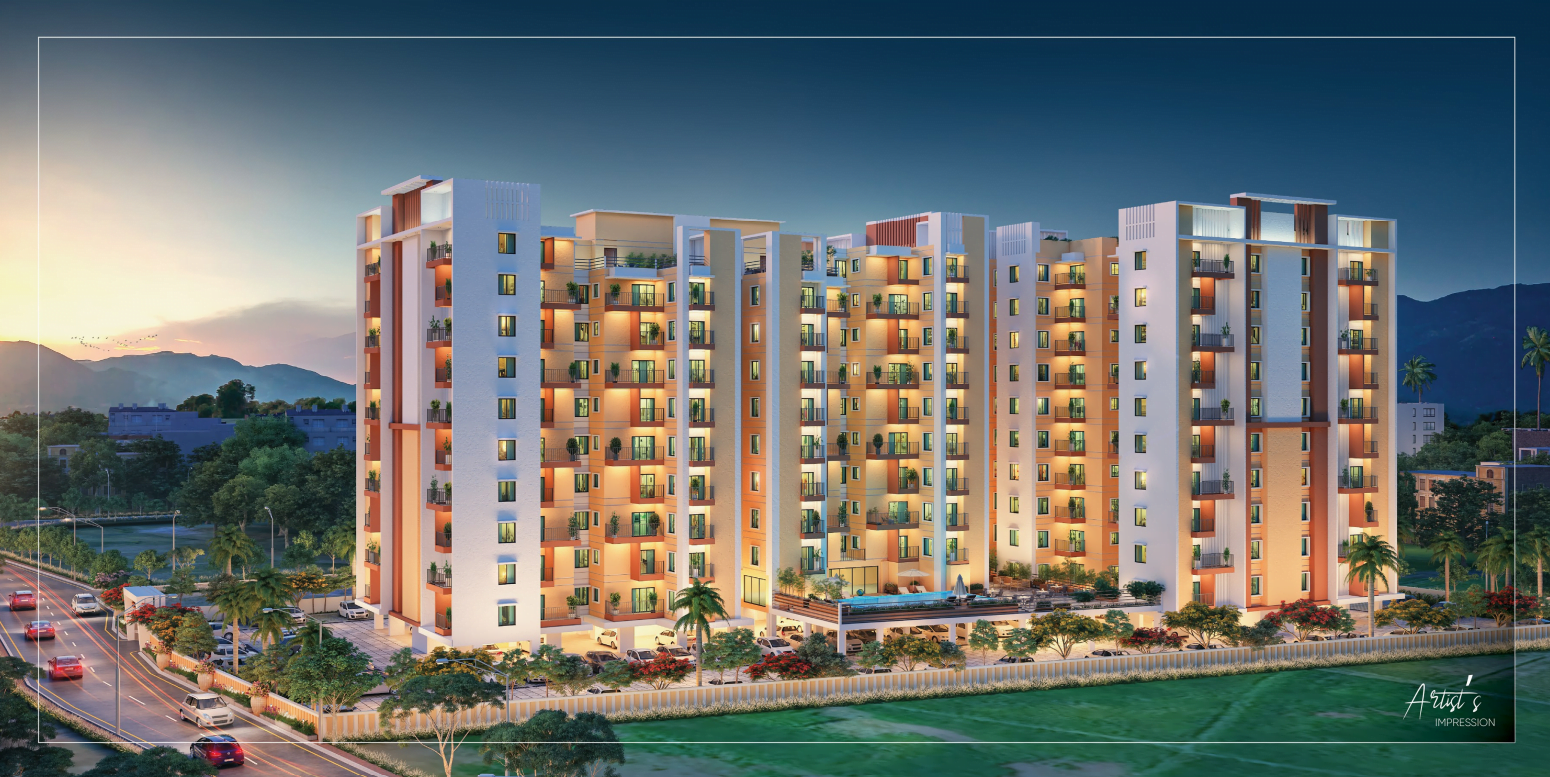


A Flat Site Visit Checklist in Guwahati can help you notice things that property brochures, photographs and online listings simply cannot show.
You’ve shortlisted a project.
The photographs look impressive.
The floor plan seems spacious.
The amenities sound great.
And the price appears to fit your budget.
But before paying the booking amount, visit the actual property.
A site visit lets you evaluate the location, approach road, neighbourhood, construction quality, apartment layout, natural light, ventilation, drainage, parking and amenities for yourself.
More importantly, it gives you an opportunity to ask questions before making one of your biggest financial decisions.
Here are 15 crucial things every homebuyer should check during a flat site visit in Guwahati.
Quick Answer: During a flat site visit in Guwahati, inspect the locality, approach road, monsoon drainage, construction quality, apartment layout, natural light, ventilation, carpet area, parking, amenities, water and power arrangements, RERA details, total price and developer track record. Visit both the project and its surrounding neighbourhood before deciding.
Table of Contents
- Research Before the Site Visit
- Check the Locality
- Inspect the Approach Road
- Check Drainage and Waterlogging
- Evaluate Construction Quality
- Verify the Actual Flat Layout
- Check Natural Light and Ventilation
- Ask About Carpet Area
- Inspect Parking
- Check Amenities
- Ask About Water and Power
- Check Safety and Security
- Verify RERA and Documents
- Ask for the Complete Price
- Research the Developer
- Visit at Different Times
- Questions to Ask the Sales Team
- Site Visit Checklist
- FAQs
Before the Site Visit: Do Your Homework
Don’t arrive at a property site without knowing anything about the project.
Spend 15–20 minutes researching it beforehand.
Check:
- Project location
- Developer
- Apartment configurations
- Approximate budget
- RERA registration
- Project status
- Expected possession
- Amenities
- Nearby landmarks
This allows you to spend the site visit verifying information rather than discovering basic information.
If you’re still at the beginning of your search, Ambika Housing’s Apartments in Guwahati for Sale guide can help you understand the major factors to compare while shortlisting apartments.
1. Check the Locality Before Checking the Flat
One of the biggest mistakes buyers make is falling in love with the apartment before evaluating its location.
Remember:
You can renovate a flat. You cannot relocate the building.
Before entering the project, look around the neighbourhood.
Check for:
- Grocery stores
- Schools
- Hospitals
- Pharmacies
- Markets
- Banks
- Restaurants
- Public transportation
- Fuel stations
- Daily conveniences
Also consider your family’s regular destinations.
How far is your office?
How far is your child’s school?
How quickly can you reach a hospital?
If you are comparing different neighbourhoods, read Ambika Housing’s Best Localities to Buy Flats in Guwahati guide before making your final shortlist.
2. Inspect the Approach Road
The entrance to the project deserves more attention than most buyers give it.
Check:
Is the road wide enough?
Can two vehicles pass comfortably?
Can emergency vehicles access the building?
Is the road properly surfaced?
Is street lighting available?
Does traffic become difficult during peak hours?
A beautiful apartment can become frustrating if entering and leaving the neighbourhood is difficult every day.
Don’t Visit Only on Sunday
A quiet Sunday afternoon doesn’t tell you what Monday morning will feel like.
If possible, understand the area during:
Morning rush hour
Evening rush hour
Rainy weather
This gives you a much more realistic picture of daily life.
3. Check Drainage and Waterlogging
For a Guwahati homebuyer, this should be high on the checklist.
Ask:
- Does the approach road experience waterlogging?
- Is the plot elevated appropriately relative to the road?
- Where does rainwater drain?
- Is basement parking protected from water entry?
- Are stormwater drains visible?
- How is rainwater managed around the building?
Don’t limit your inspection to the apartment.
Look at:
Road Level → Project Entrance → Ground Level → Parking → Building Plinth
Talk to nearby shopkeepers or residents if you want additional context about how the locality behaves during heavy rain.
Ambika Housing has a dedicated guide on Flood Resistant Buildings in Guwahati, which explains the importance of site elevation, drainage and flood-conscious property selection.
This is an excellent article to read before visiting a property during Guwahati’s monsoon season.
4. Evaluate Construction Quality
You don’t need to be a civil engineer to notice basic quality indicators.
During your site visit, observe:
- Wall finish
- Tile alignment
- Door and window installation
- Staircases
- Railings
- Common areas
- Plumbing fixtures
- Electrical fittings
- Paint finish
- Visible cracks
- Signs of seepage or dampness
For an under-construction project, ask about:
- Structural system
- Materials
- Waterproofing
- Electrical specification
- Plumbing
- Doors and windows
- Flooring
Don’t judge quality only from the sample flat.
Inspect a Completed Project Too
If the developer has older projects in Guwahati, ask whether you can visit one.
An older building can show you how the developer’s work performs after several years of:
Rain + Heat + Daily Use + Maintenance
That can be more informative than a beautifully decorated sample apartment.
5. Compare the Actual Flat with the Floor Plan
Carry or open the floor plan during your visit.
Walk through the flat and compare:
Entrance → Living Room → Dining → Kitchen → Bedrooms → Bathrooms → Balconies
Now ask yourself:
Does the layout feel practical?
Can furniture fit comfortably?
Are bedrooms private?
Is the kitchen large enough?
Is there enough storage?
Does movement between rooms feel natural?
Don’t Buy Only by BHK
Two 3BHK flats can feel completely different.
One might have three practical bedrooms and an efficient living area.
Another might waste significant space in corridors.
Look at:
Configuration + Usable Space + Layout
Ambika Housing’s article on Modern Apartment Layouts is a useful supporting guide for understanding how floor planning affects everyday living.
6. Check Natural Light
Turn off unnecessary lights if you’re viewing a completed or sample apartment.
Then observe.
Does natural daylight enter the living room?
What about the bedrooms?
Does the kitchen receive light?
Are neighbouring buildings blocking major windows?
Natural light affects how a home feels every day.
A bright apartment can feel more open and welcoming than a poorly lit apartment of similar size.
Check Orientation
Ask which direction the apartment faces and where major windows are located.
The actual experience will depend on:
- Building orientation
- Floor
- Adjacent buildings
- Window size
- Balconies
- Surrounding open space
Don’t assume every apartment in the same project gets identical light.
7. Check Ventilation
Guwahati’s warm and humid conditions make ventilation important.
Stand near the windows and balconies.
Check whether air can move through the apartment.
Look for opportunities for cross ventilation, where appropriate.
Pay particular attention to:
- Kitchen
- Bathrooms
- Bedrooms
- Living room
Ask how bathrooms without external windows are ventilated.
A well-designed apartment should consider both daylight and airflow.
8. Ask for the Exact Carpet Area
Don’t stop at:
“This is a 1,500 sq. ft. flat.”
Ask:
“What is the exact RERA carpet area of this unit?”
The overall quoted area and usable internal area may not be the same.
Knowing the carpet area makes it easier to compare two projects fairly.
Also ask for:
- Room dimensions
- Balcony dimensions
- Floor plan
- Unit orientation
This information helps you understand what you are actually purchasing.
9. Inspect the Parking Area
Parking problems become daily problems.
Check:
- Parking size
- Entry and exit
- Ramp width
- Turning space
- Lighting
- Ventilation
- Drainage
- Security
If you own a larger vehicle, make sure the parking arrangement is genuinely practical.
Ask whether parking is:
Allotted
or
Common
and how the right to use it is documented.
If EV charging matters to you, ask whether charging infrastructure is available or planned.
For example, Ambika Housing’s Diamond Home project lists EV charging among its amenities, alongside parking and other lifestyle facilities.
10. Don’t Just Count Amenities — Inspect Them
Advertisements often highlight:
20+ Amenities
But quantity isn’t everything.
Ask yourself:
Which amenities will my family actually use?
Useful facilities might include:
- Children’s play area
- Gym
- Swimming pool
- Walking areas
- Community hall
- Security
- Sports facilities
- Green spaces
- EV charging
Then inspect:
Location + Size + Accessibility + Maintenance
A tiny gym included simply to tick an amenities box isn’t the same as a properly planned fitness space.
Ambika Housing’s guide to Flats with the Best Amenities in Guwahati provides additional points to consider when comparing amenity-rich projects.
11. Ask About Water, Electricity and Backup
These aren’t exciting questions.
But after possession, they become very important.
Ask:
Water
What is the primary water source?
Is there storage?
What backup arrangement exists?
Electricity
What is the sanctioned supply?
Power Backup
Which areas receive backup?
Only lifts and common spaces?
Or selected apartment loads too?
Lifts
How many lifts serve each building or tower?
Is there a service lift?
What happens during a power cut?
Understand the actual specifications rather than assuming.
12. Check Safety and Security
Evaluate the project from the perspective of everyday safety.
Check:
- Security personnel
- CCTV
- Controlled entry
- Fire-safety systems
- Staircases
- Emergency exits
- Lighting in common areas
- Lift safety
- Railings
- Children’s areas
For high-rise or larger apartment developments, ask the developer about the project’s applicable fire and safety approvals.
Don’t assume that a security guard at the entrance represents the entire safety system.
13. Verify RERA Before Paying the Booking Amount
A site visit should also be a documentation visit.
Ask for the project’s:
RERA Registration Number
Then independently verify the applicable project information.
Don’t rely only on a number printed in the brochure.
Ambika Housing’s What Is RERA Number in Real Estate? guide explains what RERA registration means and how buyers can approach verification.
Ambika’s broader apartment-buying guide likewise recommends verifying RERA registration before booking.
Also ask to review or independently verify relevant:
- Land/title documentation
- Approved plans
- Permissions
- Agreement terms
- Possession timeline
For a major property purchase, independent legal review can be worthwhile.
14. Ask for the Complete Price — Not Just the Base Price
Suppose the salesperson tells you:
“The flat costs ₹70 lakh.”
Ask:
“What will be my complete acquisition cost?”
Depending on the property and transaction, additional amounts can include applicable:
- Registration-related charges
- Taxes
- Parking-related charges
- Maintenance deposits
- Utility-related charges
- Other disclosed project charges
Ask the sales team for a written cost sheet.
Then compare projects using:
Total Cost
rather than only:
Base Flat Price
For broader pricing research, read Ambika Housing’s Property Price in Guwahati guide.
15. Research the Developer’s Track Record
The developer matters almost as much as the project.
Ask:
How long has the developer operated?
How many projects have been completed?
Can I visit them?
Were previous projects delivered?
How are older properties maintained?
What do existing residents say?
Ambika Housing says it has been developing property in Guwahati since 2002. Its current site also presents completed and ongoing projects that buyers can investigate before making a decision.
That is exactly the type of track record buyers should examine — regardless of which developer they are considering.
For a more detailed framework, read Ambika Housing’s guide to choosing among Residential Real Estate Companies in Guwahati.
Bonus: Visit the Property Twice
If you’re seriously considering purchasing the flat, don’t restrict yourself to one visit.
Visit 1: Daytime
Check:
- Natural light
- Construction
- Neighbourhood
- Views
- Amenities
Visit 2: Evening
Check:
- Traffic
- Street lighting
- Noise
- Security
- Neighbourhood activity
If possible, also understand how the locality behaves during monsoon conditions.
A property that looks perfect at 11 AM may feel very different at 7 PM.
Talk to People Outside the Sales Office
One of the most underrated parts of a property site visit is speaking to people who aren’t selling you anything.
If possible, talk to:
- Existing residents
- Neighbours
- Nearby shopkeepers
Ask simple questions:
How is the area during rain?
How is traffic?
How is water availability?
Is the neighbourhood noisy?
Are there any recurring issues?
Treat individual opinions as inputs rather than absolute facts, but they can reveal questions worth investigating further.
Flat Site Visit Checklist in Guwahati
Save this checklist on your phone before your next property visit.
Location
☐ Distance from office
☐ Schools nearby
☐ Hospitals nearby
☐ Markets and daily needs
☐ Public transport
Connectivity
☐ Approach road
☐ Peak-hour traffic
☐ Alternative routes
☐ Road condition
Monsoon
☐ Waterlogging history
☐ Site elevation
☐ Drainage
☐ Basement protection
Apartment
☐ Carpet area
☐ Room dimensions
☐ Floor plan
☐ Natural light
☐ Ventilation
☐ Balcony
☐ Kitchen
☐ Storage
Building
☐ Construction quality
☐ Lifts
☐ Common areas
☐ Fire safety
☐ Security
Parking
☐ Parking allocation
☐ Parking dimensions
☐ Entry/exit
☐ Drainage
☐ EV charging if required
Amenities
☐ Amenities physically inspected
☐ Maintenance implications understood
Documentation
☐ RERA verified
☐ Approved plans checked
☐ Legal documents reviewed
☐ Possession date confirmed
Money
☐ Written cost sheet
☐ Total purchase cost
☐ Maintenance charges
☐ Payment schedule
Developer
☐ Track record checked
☐ Completed project visited
☐ Resident feedback considered
Questions to Ask the Sales Team During a Site Visit
Don’t leave the site without asking these questions:
1. What is the exact RERA carpet area?
2. What is the total price including applicable charges?
3. What is the RERA registration number?
4. What is the committed possession timeline?
5. Which amenities are included?
6. What are the expected maintenance charges?
7. What is the parking arrangement?
8. What is the water source?
9. What power backup is provided?
10. Which approvals have been obtained?
11. Can I review the relevant approved plan?
12. Can I visit one of your completed projects?
13. What exactly will be provided inside the apartment at possession?
14. Are there additional charges not included in the quoted base price?
15. Who should I contact after possession for defects or service issues?
Take notes.
When you visit the next project, ask the same questions.
Now you have a proper comparison.
Using a Site Visit to Compare Apartments in Guwahati
Don’t choose a property immediately after seeing the first impressive sample flat.
Shortlist two or three realistic options.
Then create a simple scorecard.
| Factor | Project A | Project B | Project C |
|---|---|---|---|
| Location | /5 | /5 | /5 |
| Connectivity | /5 | /5 | /5 |
| Drainage | /5 | /5 | /5 |
| Layout | /5 | /5 | /5 |
| Natural Light | /5 | /5 | /5 |
| Construction | /5 | /5 | /5 |
| Amenities | /5 | /5 | /5 |
| Developer | /5 | /5 | /5 |
| Documentation | /5 | /5 | /5 |
| Value for Money | /5 | /5 | /5 |
| Total | /50 | /50 | /50 |
The scoring isn’t scientific.
Its purpose is to stop one beautiful lobby or attractive sales offer from dominating the entire decision.
Site Visit and Future Resale Value
Your site visit isn’t only about deciding whether you would live in the property.
Think about the next buyer too.
Ask:
Will another family like this location?
Will the building remain accessible?
Is the layout practical?
Are the amenities useful?
Will parking remain convenient?
Does the project appear maintainable?
Is the developer’s reputation likely to help buyer confidence?
These factors can influence the future resale value of a flat in Guwahati.
So your site visit is both:
A Home Inspection
and
An Investment Check.
Planning a Site Visit with Ambika Housing
Ambika Housing has been developing residential and commercial property in Guwahati since 2002.
Its portfolio gives prospective buyers the opportunity to evaluate actual projects rather than making a decision based only on online photographs.
For example, buyers interested in amenity-focused apartment living can explore Diamond Home, while Ambika’s broader portfolio provides additional residential options.
Ambika’s own buyer guidance recommends physically visiting the site, checking construction quality and walking through available/sample units rather than booking solely from brochures.
When you visit an Ambika Housing project, use the same checklist from this article:
Location → Drainage → Construction → Layout → Light → Amenities → Documents → Cost
A good developer should be comfortable with an informed buyer asking detailed questions.
Explore Apartments in Guwahati for Sale, view Diamond Home, or Contact Ambika Housing to arrange a project visit.
Frequently Asked Questions
What should I check during a flat site visit in Guwahati?
Check the location, approach road, drainage, construction quality, carpet area, layout, natural light, ventilation, parking, amenities, water, power backup, RERA details, total price and developer track record.
Why is a site visit important before buying a flat?
A physical visit allows you to inspect factors that photographs and brochures may not reveal, including road access, noise, natural light, actual room proportions and surrounding development.
Should I visit a flat during the rainy season in Guwahati?
When practical, seeing how the locality behaves during wet weather can provide useful information about drainage and access. You can also ask residents about historical waterlogging.
What documents should I ask for during a site visit?
Ask for the project’s RERA registration details and information on applicable approved plans, title/ownership documentation, agreement terms and possession schedule. Consider independent legal verification before purchasing.
Should I check carpet area during a site visit?
Yes. Ask for the exact carpet area of the unit and compare it with the floor plan and actual room dimensions.
What should I check in a sample flat?
Evaluate room dimensions, furniture space, kitchen practicality, bathrooms, storage, balconies, natural light and ventilation. Also confirm which finishes shown in the sample flat are actually part of the purchase specification.
Should I inspect parking before buying?
Yes. Check the parking dimensions, vehicle movement, entry and exit, lighting, drainage and how parking rights are allocated.
How do I check a builder before buying a flat?
Research completed projects, delivery history, regulatory information, construction quality and resident feedback. Visiting an older completed project can be particularly useful.
How many properties should I visit before buying?
There is no fixed number. Compare enough realistic options to understand the market and make an informed decision rather than buying simply because it is the first project you liked.
How can I schedule a site visit with Ambika Housing?
Visit Ambika Housing’s project pages to shortlist a suitable apartment and use the Contact Ambika Housing page to enquire about availability and arrange a project visit.
Final Takeaway
A Flat Site Visit Checklist in Guwahati helps turn a property visit from a sales presentation into a proper buying decision.
Don’t visit only to see:
The Kitchen.
The Bedroom.
The Balcony.
Look beyond the apartment.
Check:
Location.
Traffic.
Drainage.
Construction.
Layout.
Natural light.
Parking.
Amenities.
RERA.
Total cost.
Developer track record.
And don’t hesitate to ask difficult questions.
A home may look impressive for 30 minutes during a site visit.
Your goal is to determine whether it will still feel like the right decision years after you move in.