

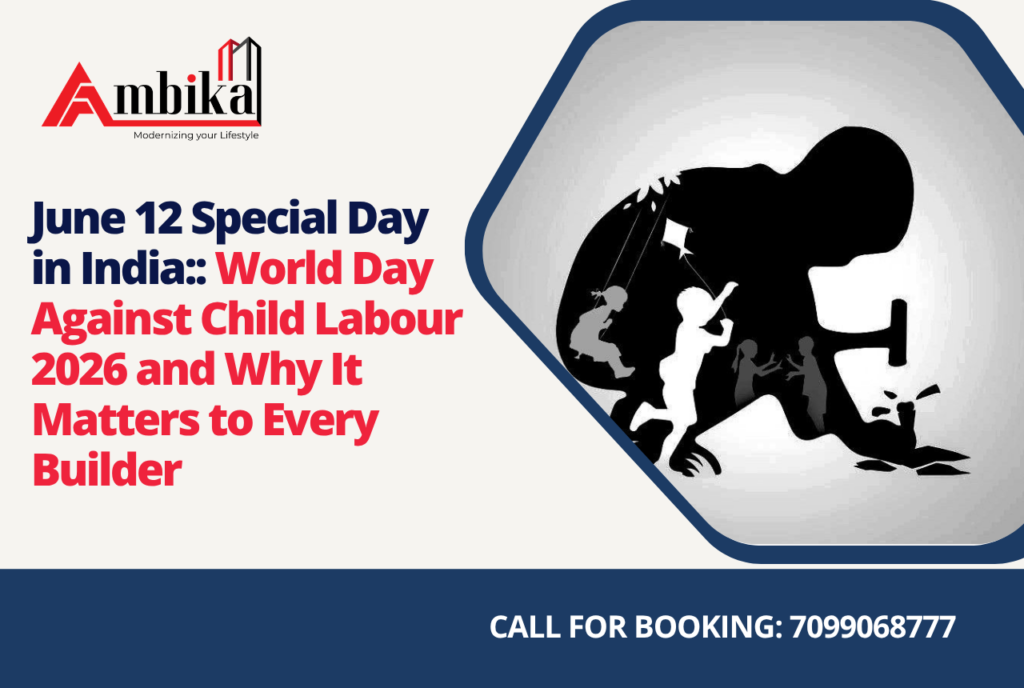
World Day Against Child Labour 2026: Every date on the calendar carries a story, but few are as meaningful as June 12. If you have searched for the special day on June 12 in India, here is the short answer: it is observed worldwide as the World Day Against Child Labour — a day set aside to remind us that no child should trade a classroom for a construction site, a playground for a factory floor.
At Ambika Housing, this date holds a special place. Our parent company, the Ambika Group, was founded in 2002 — the very same year the International Labour Organization (ILO) launched the World Day Against Child Labour. Two decades of building homes across Assam have taught us that a strong foundation is never made of concrete alone; it is built on dignity, fair work, and the promise that the next generation grows up safe.
What Is the Special Day on June 12 in India?
June 12 is observed as the World Day Against Child Labour. It is a global awareness day established by the International Labour Organization in 2002 to focus the world’s attention on the urgent need to end child labour. In India — a country with one of the largest child populations in the world — the day carries deep significance, prompting governments, schools, businesses, and communities to renew their commitment to protecting children’s rights.
While June 12 is best known for this cause, it is also a date of broader reflection on labour rights, education, and social justice — themes that touch every industry, including real estate and construction.
A Brief History of World Day Against Child Labour
The story of June 12 as a day of action is rooted in decades of global advocacy:
- 2002 — The ILO launched the first World Day Against Child Labour to spotlight the scale of child exploitation and mobilise governments worldwide.
- 1999 — The Worst Forms of Child Labour Convention was adopted, laying the legal groundwork for identifying and eliminating the most hazardous forms of child work.
- Every June 12 since — Governments, trade unions, employers, and civil society come together under a fresh annual theme to measure progress and recommit to change.
World Day Against Child Labour 2026 Theme
The theme for 2026 is “Red Card to Child Labour: Fair Play for Children, Decent Work for Adults.” Borrowing the language of sport, the “red card” symbolises sending child labour off the field for good.
The theme makes a powerful, two-part argument that resonates strongly with the construction sector:
- Fair play for children — every child deserves the right to learn, play, and grow in a safe environment, free from hazardous work.
- Decent work for adults — when parents earn fair wages and have stable jobs, families are not forced to send their children to work. Decent adult employment is the most reliable cure for child labour.
According to the ILO, around 138 million children remain in child labour worldwide, including nearly 54 million in hazardous work that threatens their health and safety. The 2026 campaign calls for stronger laws, quality education, social protection, and responsible practices across supply chains.
Child Labour in India: The Reality
India has made significant legal progress. The Child Labour (Prohibition and Regulation) Amendment Act, 2016 prohibits the employment of children below 14 years in all occupations, and bars adolescents aged 14–18 from working in hazardous industries — construction included.
Yet enforcement remains a challenge, particularly in informal and unorganised sectors. Construction sites, brick kilns, and roadside labour are areas where vulnerable migrant families sometimes bring children to work. Recognising this reality is the first step toward responsible action — and it is precisely why builders carry a special responsibility on June 12.
Why June 12 Matters to the Real Estate and Construction Industry
Construction is one of the largest employers in India and one of the sectors most exposed to the risk of child and adolescent labour. That makes the industry not a bystander on June 12, but a key player. A responsible developer can break the cycle
- Strict age verification of all on-site workers and contractor staff.
- Fair, timely wages for adult labourers so families are never forced to rely on a child’s income.
- Safe site conditions and accountability extended across every subcontractor and supplier.
- Support for workers’ families, including awareness about schooling and childcare near project sites.
In short, the homes a builder delivers should never come at the cost of a stolen childhood. That belief sits at the heart of how we work.
Ambika Housing’s Commitment to Ethical Construction
Since 2002, Ambika Housing has built residential apartments, commercial spaces, and plotted developments across Guwahati and wider Assam on a foundation of quality construction, transparent dealings, and timely delivery. Our values extend to the people who build our projects:
- Zero tolerance for child labour on any Ambika Housing site or within our contractor network.
- Ethical labour practices that prioritise fair wages, safety, and dignity for every worker.
- Community responsibility rooted in our two-decade presence in the Northeast Indian real estate market.
When you invest in a home with us, you are investing in a project built the right way — by adults, fairly paid, working safely. That is the kind of trust we want our name to stand for in Assam.
How You Can Make a Difference This June 12
Ending child labour is a shared responsibility. Here is how individuals, families, and businesses in Assam can show the “red card” this year:
- Spread awareness about the World Day Against Child Labour on social media and within your community.
- Support local NGOs and education initiatives that keep vulnerable children in school.
- Choose builders, brands, and suppliers that follow ethical labour practices.
- Report instances of child labour to local authorities and the childline helpline (1098).
Conclusion: Building a Future Worth Believing In
June 12 is more than a date — it is a reminder that real progress is measured not just in skylines, but in the childhoods we protect along the way. As Assam grows, the homes we build should reflect the values we want the next generation to inherit: fairness, safety, and opportunity.
This World Day Against Child Labour, Ambika Housing stands with the call for a red card to child labour — and a fair playing field for every child.
Frequently Asked Questions (FAQ)
Which special day is celebrated on June 12 in India?
June 12 is observed as the World Day Against Child Labour, a global day established by the ILO in 2002 to raise awareness and drive action against child labour.
What is the theme of World Day Against Child Labour 2026?
The 2026 theme is “Red Card to Child Labour: Fair Play for Children, Decent Work for Adults,” emphasising quality education for children and decent work for adults.
Who started World Day Against Child Labour?
It was launched by the International Labour Organization (ILO), a United Nations agency, in 2002.
Is child labour banned in the construction industry in India?
Yes. Under the Child Labour (Prohibition and Regulation) Amendment Act, 2016, children below 14 cannot be employed in any occupation, and adolescents aged 14–18 cannot work in hazardous industries such as construction.
How does Ambika Housing prevent child labour?
Ambika Housing maintains a zero-tolerance policy on child labour, verifies the age of all on-site workers, ensures fair wages for adult labourers, and extends accountability across its contractor network.